The short answer: installed water submetering runs roughly $150 to $4,000 per unit depending on which technology you choose, plus $5 to $22 per unit per month in ongoing subscription and billing fees. That range is enormous, and the reason is simple: the submeter itself is often the smallest line item on the invoice. What actually drives your cost is whether you need a plumber, whether you have to build a network to get the data out of the building, and what you pay every month for the next ten years.
Before we get into the numbers, one thing worth knowing. Almost nobody in this industry publishes pricing. The two vendor pages that rank highest for "how much does submetering cost" contain zero dollar figures between them. Both send you to a quote form. This guide publishes the numbers, with sources, so you can budget before you ever talk to a salesperson.
At a glance: all-in cost by submeter type
If you only read one row, read the last two columns. Network infrastructure and the monthly fee are where submetering budgets go wrong.
The five costs of any submetering project
Most people price a submetering project by pricing the submeter. That is how projects go over budget. Every system has five cost components, and for some technologies the submeter is under 10% of the total.
1. Hardware
The submeter itself. Ranges from about $60 for a poly-body mechanical in-line submeter to $3,000+ for an industrial wired clamp-on transmitter. Covered by type below.
2. Installation and plumbing
Does a licensed plumber have to cut into your pipe? Does the water have to be shut off? How long does each unit take? This single question moves the per-unit cost by hundreds of dollars.
3. Connectivity infrastructure
This is the buried cost. How does the reading get from the pipe to your dashboard? Some systems need gateways, collectors, repeaters, wiring, or a working Wi-Fi network at the pipe. Others need nothing at all. If you are comparing quotes, this is the line item most likely to be missing.
4. Software and billing
The platform that turns readings into resident bills. Often a separate recurring fee, sometimes a separate vendor entirely.
5. Ongoing costs
Connectivity, subscription, battery and submeter replacement, recalibration, and read labor. Over a ten-year horizon this is frequently larger than everything above it combined.
The five types of water submeters, and what each really costs
In-line submeters
Installed inside the pipe. The pipe is cut, the submeter is spliced in, and water is shut off to do it. Highly accurate when new, and the long-standing standard for utility billing.
Hardware
A 3/4" to 1" residential in-line submeter runs roughly $60 to $250. Poly bodies sit at the bottom (about $60 for 3/4"), bronze multi-jet in the middle (about $95), and positive-displacement units at the top (about $242 for the same 3/4" size, per published vendor list pricing and retail pricing). Commercial 1-1/2" to 2" bodies run $370 to $675, per a California water district's published January 2026 rate schedule. Note the non-linearity: in that same schedule, a 2" body costs roughly eight times a 5/8" body.
Install
This is where in-line gets expensive. Plumber labor runs $75 to $150 per hour for residential work (HomeGuide), and a utility's published 2026 schedule budgets about two hours of labor per unit at $95.86/hour. Per door, the best named industry figure comes from a director of operations quoted in CooperatorNews Chicagoland: about $150 per door for new construction, and $250 to $350 per door for retrofit. Costs climb with brittle piping, awkward pipe locations, and unit entry.
Network infrastructure
None, and that is not the saving it sounds like. Nothing carries the reading anywhere, so someone has to walk the property and read every submeter by hand.
Ongoing
A utility cost-benefit analysis puts manual reads at $3.77 to $7.06 in labor each, or $4.58 to $8.81 fully loaded (WSSC Water AMI Cost-Benefit Analysis). At monthly reads that is $55 to $106 per unit per year, forever.
The hidden cost nobody quotes you
Mechanical submeters have moving parts. They wear, they slow, and they under-register. In that same utility analysis, revenue recovered from replacing aged, under-registering meters was the single largest benefit line in the entire 20-year model, larger than all labor savings combined by more than 10x. Expect replacement every 15 to 20 years, and AWWA guidance recommends testing 5/8" to 1" meters every 10 years. The dominant lifetime cost of a mechanical in-line submeter is the water it quietly stops counting.
Best for
New construction, where the pipe is already open and there is no retrofit labor to pay for.
Smart in-line submeters (AMR/AMI)
Same in-the-pipe installation, with a radio added so you do not have to walk the property. The readings hop to a collector or gateway and then to the cloud.
Hardware
The body, plus an endpoint radio. Real procurement pricing from a 2024 utility sole-source purchase puts endpoint radios at $105 each in bulk, while a published 2026 rate schedule lists a single AMI module at $264.40, flat across every size. The radio does not scale with pipe size, only the body does.
Install
Identical to in-line: a plumber, a pipe cut, and a water shutoff, at $150 to $350 per door. Adding a radio does not remove the plumbing.
Network infrastructure
This is the part people miss. A fixed network needs collectors and repeaters. From that same procurement document: collectors at about $8,837 each and repeaters at about $6,550 each. The propagation study for that project covered 11,407 meters with 5 collectors and 32 repeaters. Repeaters outnumbered collectors six to one, which means the collector count badly understates what a fixed network costs to stand up. Across six utility deployments, all-in AMI cost lands at $200 to $750 per meter, clustering around $350 to $450.
Ongoing
No more manual reads, but you now own a network. The same utility budgeted $516,000 to $1,908,000 per year just to operate it.
Best for
Large utility-scale deployments where the fixed network amortizes across thousands of endpoints. For a single property, the gateway and repeater math rarely works.
Over-the-pipe wired
Mounted on the outside of the pipe, so no cutting and no shutoff. But it needs power and a wire home.
Hardware
Industrial clamp-on transit-time units run $1,849 to $3,130 for the device and transmitter (published pricing), well above every other category on this list.
Install
It needs 24V DC or a 110V-to-12V transformer, so it must be wired to a power source. It also needs its data output (pulse, 4-20mA, Modbus, or BACnet) wired back to a logger, panel, or building management system. That means a commercial or controls electrician at $100 to $200 per hour, a $100 to $200 service call, and wiring at $0.40 to $8.00 per linear foot depending on type (HomeGuide).
Network infrastructure
Every reading travels down a wire, so you are quietly building a small data network: conduit, low-voltage cable, and a logger or panel to collect it all.
Ongoing
Low once it is in. No subscription is inherent to the hardware, though you still need software to turn readings into resident bills.
The multifamily problem
Pipes live in risers, crawlspaces, and mechanical closets, which frequently have no outlet nearby. Every metering point may need a new circuit or transformer drop, plus a conduit run back to a central panel. A wired over-the-pipe point lands at $2,000 to $4,000+ installed once you add it all up.
Best for
A small number of large commercial mains where accuracy matters and one wiring run serves a single large device.
Over-the-pipe Wi-Fi
Also mounted outside the pipe, and fast to install because no plumber is required. Then reality arrives.
Hardware
Device costs run roughly $200 to $1,200 depending on tier, the cheapest entry point in this guide.
Install
No plumber and no pipe cutting, which is the real appeal. But nearly every consumer-grade Wi-Fi water device requires a wall outlet, typically within about 10 feet of the pipe, and several have no battery backup at all. If there is no outlet at your pipe, you are hiring an electrician after all.
Network infrastructure
No gateway to buy, but you are leaning on the building's Wi-Fi, specifically 2.4 GHz, reaching all the way to the pipe. Vendor support documentation openly blames dropped connections on distance from the router and interference from concrete walls and metal. That describes basements, mechanical rooms, and utility closets almost perfectly, which is exactly where submeters go.
Ongoing
$0 to $15 per unit per month. Some models advertise no mandatory fee at all, which is a real advantage on paper.
The multifamily problem
This category is built for homeowners first, and it surfaces three ways. In an occupied unit the device runs on your resident's Wi-Fi and your resident's electricity, so your billing data depends on infrastructure you do not own. If they unplug it, change the router password, cancel their internet, or move out, the readings stop, and every turnover becomes a re-provisioning event. The consumer apps are designed around a single home, so multifamily support is bolted on through per-device accounts and manual sharing, usually with no property-level dashboard. And some of these products attach to the utility meter rather than the pipe, which means on a shared master meter they report total usage with no way to tell units apart, defeating the entire purpose of submetering. We go deeper in cellular versus Wi-Fi for water monitoring.
Best for
Single-family homes and owner-occupied properties where the owner controls the network and the outlet.
Over-the-pipe cellular
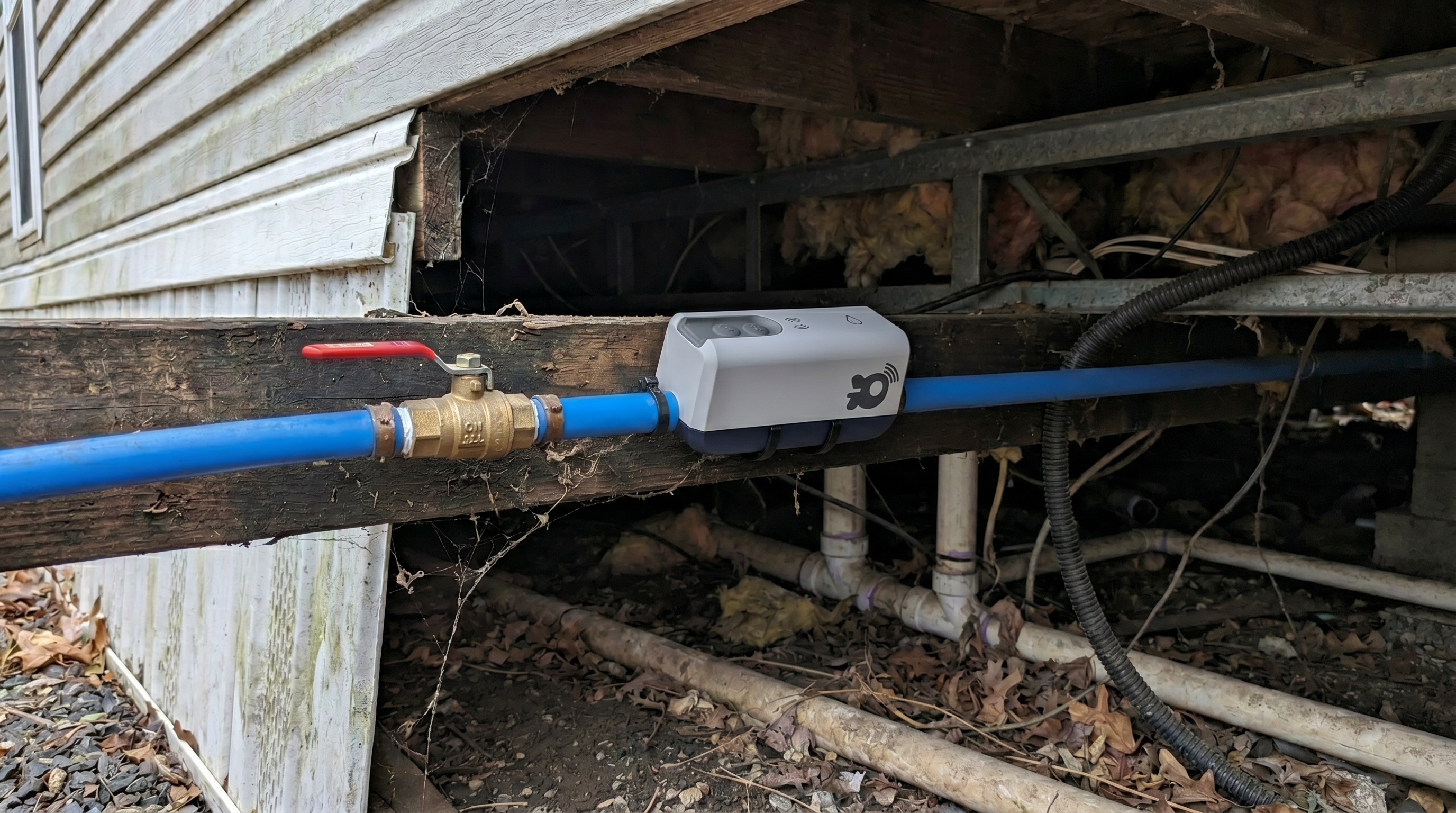
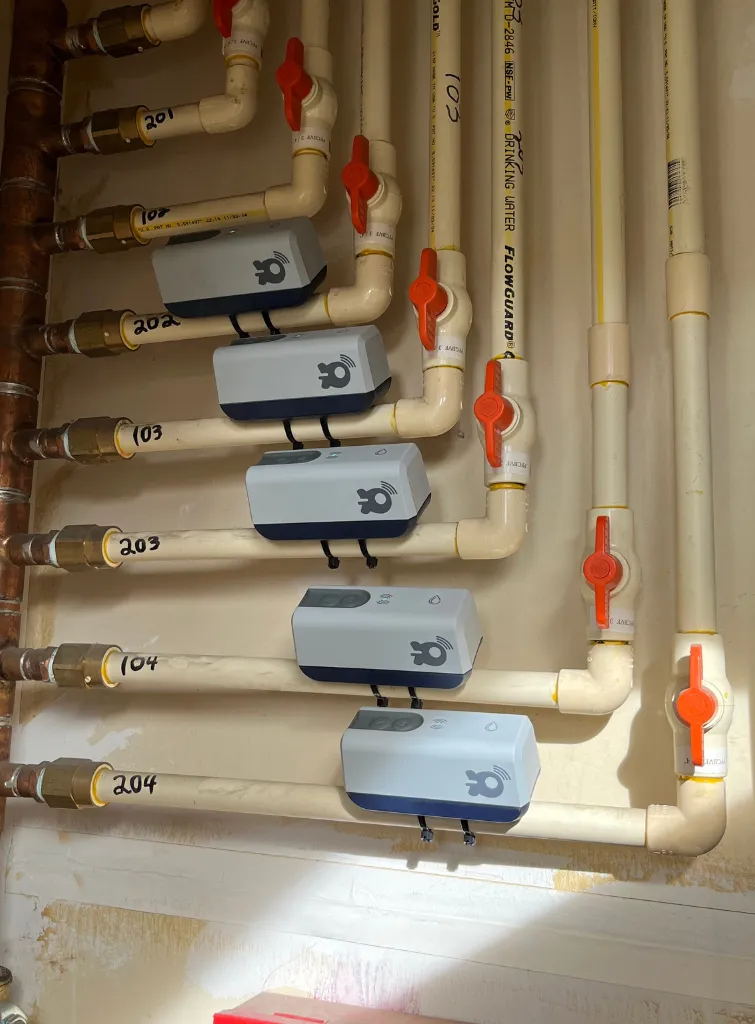
Also mounted on the outside of the pipe, but battery-powered and connected over cellular. No plumber, no electrician, no outlet, no Wi-Fi, no gateway, no repeater, and no dependency on your resident's network.
Hardware
SimpleSUB submeters are $349 (i1, indoor, pipes up to 1"), $399 (x1, outdoor-rated), and $999 (x2, pipes up to 2"). Full details on the pricing page.
Install
The submeter straps to the outside of your existing pipe with two tamper-resistant zip-ties. No pipe cutting, no water shutoff, no plumbing license, and typically no need to enter a resident's home. Most units install in under five minutes, and clamp-on installation cuts install cost by roughly 50 to 70% against cutting a submeter in. See how installation actually works and our clamp-on best practices.
Network infrastructure
None. Each submeter carries its own cellular radio and self-selects the strongest network. There is no gateway to buy, no repeater ratio to calculate, no collector to site, and no Wi-Fi to depend on. Compare that to the roughly one repeater per 40 units that RF network architectures require, or the $8,800 collectors above.
Ongoing
$6 per unit per month (i1 and x1) or $10 (x2), covering cellular connectivity, the dashboard, automated reads, leak alerts, billing software, and support. Market subscriptions generally run $5 to $15 per unit per month, and that is often before a separate billing fee. The battery lasts 10 years, and there are no moving parts to wear out or recalibrate.
Accuracy
100% within ±5%, independently validated. Revenue-grade certification is not required in most states for cost recovery. See the independent accuracy validation.
Best for
Retrofits, multifamily, mobile home parks, HOAs, and any property where the pipes sit nowhere near an outlet or a strong Wi-Fi signal. Particularly strong for mobile home parks, where pipe runs are long, exposed, and nowhere near a router.
The recurring costs everyone forgets
Hardware is a one-time expense. These repeat every month.
Subscription and connectivity: $5 to $15 per unit per month across the market.
Third-party billing fees: here is the one that surprises people. Many owners buy submeters and then discover the billing is a separate vendor and a separate bill, commonly $4 to $7 per unit per month, sometimes with a setup fee around $10 per unit. A RUBS billing service runs about the same. Stack that on a subscription and your true recurring cost can hit $10 to $22 per unit per month.
The small property penalty: many third-party billing companies will not serve properties under about 100 units, and below roughly 20 units the fee often cannot be fully passed through to residents, so the owner absorbs it.
Regulatory fee caps: some states cap what you can charge residents for the service. California caps the billing and administrative fee at the lesser of $4.75 or 25% of the amount billed. Texas caps the service charge at 9% of submetering costs allocated per unit. These caps limit how much of your recurring cost is legally recoverable, so budget them as a hard constraint. If you are in Colorado, see our HB25-1090 guide.
Battery and hardware replacement: mechanical submeters get replaced every 15 to 20 years. Sealed electronic units effectively get replaced when the battery dies. Budget it as a capital event, because it is one.
What it costs at your property size
Per-unit economics change a lot with scale, and not in the direction people expect.
A 20-unit building. Gateway-based systems are brutal here, because a single collector plus a repeater can cost more than all your submeters combined and there are only 20 doors to spread it across. In-line retrofit runs $250 to $350 per door in plumber labor alone before hardware. Per-device cellular has no infrastructure to amortize, so 20 units cost exactly 20 times one unit. This is also the size where third-party billing vendors start refusing your business.
A 100-unit property. Fixed-network infrastructure finally starts amortizing, but you are now looking at two to three repeaters, a collector, and a propagation study. In-line retrofit at $300 per door is $30,000 in labor before a single submeter. Cellular clamp-on stays linear and still needs no infrastructure.
A mobile home park. Long exposed pipe runs, scattered pads, often no Wi-Fi anywhere on the property, and frequently no outlet at the riser. Wired and Wi-Fi are effectively out. This is the clearest case for cellular there is.
How to lower the cost, and who actually pays it
The most important cost fact in this entire guide: most owners pass the monthly subscription through to residents. Once you are billing on actual usage, the per-unit monthly fee typically rides along with the water charge, which means your real cost is the hardware, once.
That reframes everything above. The comparison that matters is which system costs the least to put in, and which one keeps working without you paying to maintain a network.
Typical payback across the industry runs 18 to 36 months.
The simplest path forward
Add up all five cost components honestly and a pattern emerges.
In-line submeters put your money into plumber labor and, over time, into water that aging hardware stops counting. Smart in-line adds a network you have to buy, site, and operate. Wired over-the-pipe trades the plumber for an electrician and costs more in hardware than anything else on the list. Wi-Fi looks cheapest right up until you need an outlet at every pipe and a resident's router to stay online.
Over-the-pipe cellular wins where it counts. You can find a cheaper sticker price in this category. Add up all five cost components and cellular is the cheapest way to get metered and stay metered: no plumber, no electrician, no outlet, no Wi-Fi, no gateway, no repeaters, no separate billing vendor, and a monthly fee most owners pass through to residents anyway. One vendor, one price, no infrastructure to inherit.
That is why SimpleSUB exists. Clamp it on in five minutes, press a button, and the data starts flowing. If you want to check whether your property is a fit, start with can my property be submetered, or read the ultimate guide to water submetering for the full picture. If you are evaluating vendors generally, here is how to choose a submetering partner.
Frequently asked questions
Do I need a plumber to install water submeters?
Only for in-line submeters, which are cut into the pipe and require a water shutoff. Over-the-pipe submeters mount on the outside of the existing pipe and need no plumbing work, no shutoff, and no plumbing license. Cellular clamp-on submeters install in about five minutes per unit.
What are the ongoing costs of water submetering?
Expect $5 to $15 per unit per month for subscription and connectivity, plus $4 to $7 per unit per month if billing is handled by a separate third-party vendor. SimpleSUB is $6 per unit per month for i1 and x1 submeters and $10 for the x2, with billing software included. Most owners pass this through to residents.
How much does it cost to submeter an apartment building?
Budget roughly $150 to $350 per door in plumber labor for an in-line retrofit, plus $60 to $250 per submeter. For clamp-on cellular, budget $349 to $999 per submeter with no plumber and no install labor. A 100-unit in-line retrofit can run $30,000 in labor alone before hardware. See the complete apartment submetering guide.
Do I need Wi-Fi or a gateway for water submetering?
It depends entirely on the technology. AMR/AMI fixed networks need collectors (about $8,800 each) and repeaters (about $6,550 each, roughly one per 40 units). Wi-Fi devices need a 2.4 GHz signal and a power outlet at the pipe. Cellular submeters need neither, each one connects on its own.
Is water submetering worth it?
Typical payback is 18 to 36 months. Submetering recovers 85 to 95%+ of water costs versus 70 to 85% for RUBS, and residents use 15 to 40% less water once they are billed for actual usage. See how usage-based billing pays off.
Methodology and sources
Every figure in this guide is sourced. Where a number is an estimate derived from component costs rather than a single sourced figure, it is presented as a range.
Hardware pricing. In-line submeter and body prices come from published vendor list pricing, retail pricing for positive-displacement units, and a California water district's rate schedule effective January 1, 2026. Industrial clamp-on transit-time pricing comes from published list pricing.
Installation labor. Plumber rates come from published plumber cost data, corroborated by a second independent labor-rate source. Electrician rates and wiring costs come from published electrician hourly rates and an electrical work pricing guide. Per-door retrofit figures come from an operations director quoted in a multifamily trade publication.
Fixed-network infrastructure. Collector, repeater, and endpoint radio pricing come from a 2024 utility sole-source procurement document, which also documents the propagation study behind the collector-to-repeater ratio. Fully loaded AMI benchmarks across six utility deployments, annual network operating costs, manual read labor, and the under-registration revenue analysis all come from a utility AMI cost-benefit analysis. A peer-reviewed study provides an independent AMI cost-per-meter comparison. The roughly one-repeater-per-40-units ratio is published by a submetering vendor and corroborated by another network vendor's documentation.
Connectivity. Retail gateway hardware pricing comes from published LoRaWAN gateway listings. Cellular per-device connectivity costs come from a 2025 IoT connectivity pricing guide.
Wi-Fi limitations. The power requirements, 2.4 GHz constraints, and connectivity-drop causes described above are documented in the manufacturers' own support material, not inferred: published device power requirements confirming no battery backup, a vendor troubleshooting page titled "device frequently going offline" citing router distance and concrete/metal interference, and a vendor's own guidance confirming its device cannot separate units on a shared master meter.
Billing fees and regulatory caps. Third-party billing fees come from published RUBS service pricing and an industry analysis of submetering billing costs, with vendor confirmation that fees plus setup and move-out charges apply. Fee caps come from California's water service regulations, Texas Water Code §13.503, the Texas PUC's submetering rules, and NCSL's summary of state submetering rules.
Accuracy standards and hardware lifespan. Revenue-grade accuracy requirements are defined in AWWA C700 (spec summary). Test intervals follow AWWA M6, as summarized by a water conservancy district. Replacement cycles are corroborated here.
On the claim that vendors do not publish pricing. As of July 2026, the two vendor pages ranking highest for "how much does submetering cost" contain no dollar figures at all: the first and the second. Both route the reader to a quote request instead.
Limitations, stated plainly. AMI component pricing reflects a 2024 baseline, and the source document notes a scheduled price increase, so treat those figures as a floor rather than current. Utility meter-set totals include meter boxes, lids, and pit work that in-building submeters do not require; they are used here only to anchor labor rates and hardware pricing, never presented as submeter costs. Several cost figures that circulate widely in other submetering articles could not be traced to any primary source and were deliberately excluded from this guide.
Request a Demo
We'll design an affordable, easy-to-install solution for your submetering project, large or small.