Your water bill is the only monthly report you get on a system nobody watches. This guide covers what's actually on it, how sewer charges get calculated and why that matters more than most owners expect, and the three checks that surface most problems. Five minutes is usually enough to find something. And if a check turns up something the bill can't explain, submetering often can, because it breaks the property's one number down by unit.
Key takeaways
- Your bill is at least two bills on top of each other. Water, sewer, and often stormwater, each calculated differently. Sewer is frequently the bigger number.
- Sewer is almost never measured. There's no meter on a building's drain, so utilities estimate sewer from water usage. Homeowners usually get a seasonal adjustment that keeps them from paying sewer on irrigation. Master-metered properties usually don't.
- Compare gallons, not dollars. Dollars move when rates change. Gallons move when behavior changes. Only one of those tells you something you can act on.
- Check the billing period length before you compare anything. A 33-day bill against a 28-day bill is an 18% difference before a single drop of water is involved.
- Landscape irrigation is roughly 9 billion gallons a day nationally, and the Irrigation Association estimates more than half of it is wasted to overwatering. Summer is when a master meter hides the most.
- Most building owners have never walked through their bill this way. The ones who do usually find something.
Why the bill is worth five minutes
This guide is for properties on a shared master meter, where one utility connection serves many units, suites, or pads and the owner or association receives the entire bill. If that's you, most of what's written about water bills doesn't apply to you. It's written for homeowners, who are billed under a different rate structure and get seasonal sewer protections that master-metered accounts are routinely excluded from. Those differences are most of the subject here.
Master-metered bills get one look: the amount due. Someone confirms it's roughly what it was last month, approves it, and moves on. That's a reasonable way to process an invoice and a poor way to manage an operating expense that runs six figures a year at scale.
Water is one of the few costs on the property that can rise without anyone deciding anything. A valve sticks. A controller keeps its April schedule into July. A toilet in a vacant unit runs for a month. Nothing gets approved, nobody gets notified, and the bill goes up. The bill is the only place it shows up, and it shows up late.
The bill is also the only free diagnostic you already own. Here's how to read one.
What's actually on the bill
Line items vary by utility, but nearly every commercial or master-metered bill is built from the same parts.
A fixed charge. Called a base charge, service charge, availability fee, or monthly minimum. You pay it whether you use water or not. It's usually set by the size of your meter, not your usage, which is why a large meter on a low-usage property still carries real cost. This covers the utility's infrastructure, debt service, and the fact that they have to be ready to serve you.
A volumetric charge. The per-unit price of the water you used. This is the line that responds to behavior, and it's the line to watch. Depending on the utility, it may be a single flat rate, or it may be broken into tiers.
Supply and resource fees. Charged per unit on top of the volumetric rate. Names vary: water supply fee, resource fee, CAP fee, conservation fee, drought surcharge. These are easy to skim past because they're small per unit. They're not small at property scale, and some of them escalate along with your tier.
Sewer. Its own calculation, covered below. Often the largest single component of the bill.
Stormwater or green infrastructure. Often based on impervious surface area, meaning roof and parking, not water use at all. Nothing you do with irrigation will move it.
Taxes and pass-throughs. Usually calculated on one of the subtotals above, so they scale with everything else.

The practical point: when your bill goes up, "the water bill went up" is not a diagnosis. It matters a great deal whether the increase came from volume, from a rate change, from sewer, or from a fee that has nothing to do with usage. Those have entirely different fixes, and three of the four aren't fixable at all.
The unit problem: Ccf, HCF, kgal, and "units"
Before you compare anything, find out what you're counting.
- Ccf or HCF means one hundred cubic feet. One Ccf is about 748 gallons. Most US water utilities bill this way.
- kgal means one thousand gallons.
- "Units" usually means Ccf, but confirm it. Some utilities use it to mean something else entirely.
- Some bills report usage in one unit and graph it in another.
This sounds pedantic until a board argues for twenty minutes about a number one of them thought was gallons. Convert everything to gallons before you compare anything, and write the conversion at the top of the page. The EPA's guide to understanding your water bill is a good neutral reference if you want to hand something to a skeptical board member.
How sewer charges are calculated, and why
This is the part of the bill that surprises people most, so it's worth understanding properly.

There is no meter on the building's drain. Metering what actually leaves a property through the sewer is expensive, unpleasant, and impractical at scale. So utilities don't measure it. They estimate it, and the number they estimate from is your water usage. Water in becomes the proxy for water out.
That proxy is reasonable for indoor use. Water that goes into a sink, shower, or toilet does come back out through the sewer. The proxy breaks down the moment you water the landscape, because irrigation water goes into the ground and never reaches the sewer. Bill sewer on total water and you're charging the property to treat water that never arrived at the plant.
Utilities handle this in one of a few ways, and the one that applies to master-metered properties is usually the worst of them:
Winter averaging. The utility calculates sewer from usage during winter months, when nobody's irrigating, and applies that average across the year. It's the cleanest fix and it's largely a residential courtesy. Master-metered commercial and multifamily accounts are frequently excluded.
Actual usage, year-round. Sewer is calculated from whatever water the property used that month, irrigation included. This is the common treatment for commercial and multifamily accounts, and it's probably you. Every gallon that goes on the landscape in July gets billed twice: once as water, once as sewer that was never generated. Across a few acres of turf that is not a rounding error.
A deduct meter or dedicated irrigation meter. The utility installs a separate meter on the irrigation line, and that volume is subtracted from the sewer calculation. Many utilities offer this. Many properties that qualify have never asked.
Find out which one you're on. It's the single highest-value question on this list, and it's one phone call to your utility. If you're a master-metered property with real landscape in a hot climate, there's a good chance you're paying sewer charges on that landscape, every summer, and have been for years. Ask whether winter averaging or an irrigation deduct meter is available to your account class. Sometimes the answer is no, because the exclusions are written into the rate schedule. It costs nothing to find out, and the properties that qualify are frequently the ones that never asked.
Check 1: Compare gallons, not dollars
Pull the same billing period from last year and put the two side by side.
Compare gallons, not dollars. Dollars hide rate increases. Water rates have climbed roughly 5% a year over the past decade, so a bill that's up 5% year over year might represent identical usage. Gallons show behavior. Dollars show behavior plus rate changes plus fee changes, mixed together in a way you can't separate by looking.
Normalize for the billing period first. Utility billing periods follow meter read dates, not calendar months, so they run anywhere from about 28 to 33 days. Divide gallons by the number of days in the period and compare gallons per day. Otherwise you're comparing a long month to a short one and calling the difference a trend.
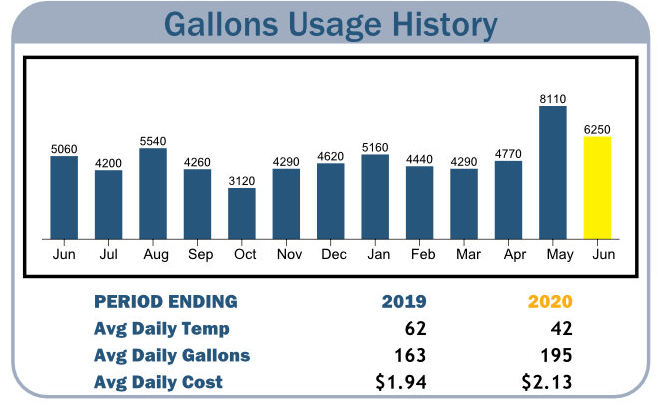
Then look at the shape, not just the total. Most bills print a 12-month usage graph, and many print the prior 12 months alongside it. That graph is the most useful thing on the page and the most ignored. You're looking for the summer curve. Every property in a climate with seasons has one. The questions are how tall it is, whether it's taller than last year's, and whether it comes back down.
A summer bump is normal. A summer bump that's meaningfully bigger than last year's, on a property where nothing changed, is a question worth answering. A summer bump that never fully returns to the winter baseline is usually a leak that started in spring and never stopped.
Check 2: Find out what your most expensive water costs
First, find out whether you're on tiers at all. This trips up a lot of boards. Tiered rates, where the per-unit price climbs as usage climbs, are largely a residential structure. Master-metered properties are commonly billed on a commercial rate instead, which is often a single flat price per unit regardless of volume. Don't assume either way, and don't assume the advice you read about tiers applies to your account. Look at the volumetric lines on your own bill. Two or more different rates on the same meter means you're tiered. One rate means you're not.
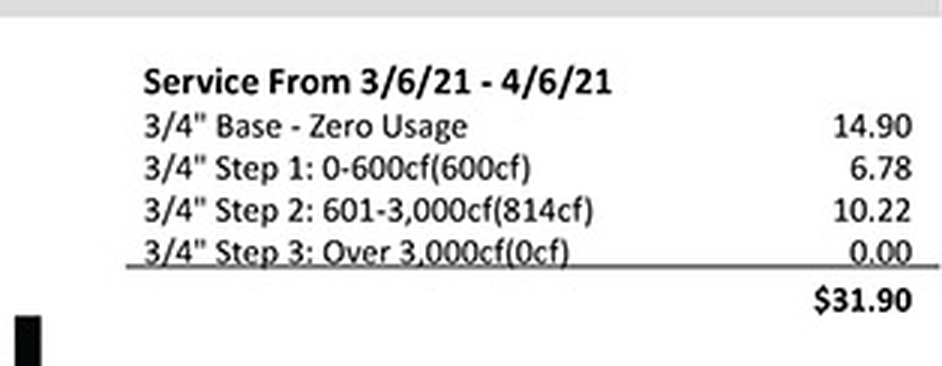
If you're on tiers, look at how much of your usage landed in the top one. That's your most expensive water, and in summer it's usually irrigation. The tier structure means your last gallons cost more than your first ones, so the marginal cost of overwatering is higher than your average rate suggests. If you're estimating what a fix is worth, price it at the top-tier rate, not the blended one. Watch the per-unit fees too, since some utilities escalate conservation fees by tier alongside the base rate.
If you're on a flat commercial rate, tiers aren't your problem, but volume still is. You're paying the same price for the wasted gallons as the useful ones, and the sewer question above may matter more to you than it does to a tiered account.
Either way, this is where master metering costs you. One meter aggregates every unit, the common areas, and the irrigation into a single number. On a tiered account, that combined volume pushes the whole property into premium tiers even when no individual resident is doing anything unusual. On any account, it means you can see the total and nothing else. We go deeper on this in How Tiered Water Rates and Drought Pricing Work.
Check 3: See whether usage responds to rain
This is the check almost nobody runs, and it's the one that most often finds something.
Pull up the weather for your billing period. Find the rainy stretch. Now look at whether your usage dropped.
If it didn't, your controllers are watering on a schedule, not on need. They ran through the rain. They'll run through the next one. The system is doing exactly what it was told to do. The instructions are the problem. Nationally, landscape irrigation runs about 9 billion gallons a day, and the Irrigation Association estimates more than half of it is wasted to overwatering. Schedule-based controllers are a large part of why.
A monthly bill is a blunt instrument for this. You're comparing one number against a month of weather, so you'll only catch it if the rain was significant and the schedule was clearly indifferent to it. If your utility offers online usage data at daily or hourly resolution, use that instead. Many do now, and almost nobody logs in.
The fix here is often free. Adjust the schedule seasonally. Add a rain sensor if there isn't one. Smart controllers can cut outdoor use meaningfully, with vendor estimates in the 30 to 50% range, though treat those as estimates from interested parties and expect your own results to depend on how bad the current schedule is.
Other things worth flagging

Estimated reads. If the utility couldn't get to your meter, they estimated your usage from history. It's usually marked with an "E" or the word "estimated." Estimates get trued up on the next actual read, which means a catch-up bill that can look alarming and isn't. Two or three estimated reads in a row is worth a call, because it means nobody has physically looked at your meter in months, and a real problem could be hiding inside the estimate.
Zero or implausibly low usage. Rarely good news. Usually a meter that stopped or a read that didn't happen.
A usage alert printed on the bill. Some utilities flag abnormal usage right on the statement. It's easy to miss inside a multi-page packet. If your property has several accounts, the alert may be on page nine of a stack nobody opens past page one.
Multiple accounts. Larger properties often have several utility accounts across buildings, irrigation lines, and common areas. Reconcile the total across all of them, because a problem on one account can be invisible in a total that's dominated by the others.
What to do with what you find
Most of what turns up in five minutes is fixable without spending anything:
- Ask your utility whether winter averaging or an irrigation deduct meter is available to your account class.
- Reset irrigation schedules for the season and add a rain sensor.
- Confirm your meter size matches your actual demand, since you're paying a fixed charge for it either way.
- Log into your utility's online portal and find out what usage data you already have access to.
What five minutes with a bill can't do is tell you where the water went. That's the structural limit of a master meter. It gives you one number for the entire property, once a month, four to six weeks after the fact. You can see that usage rose. You can't see which building, which unit, or whether it was irrigation at all. You're left comparing totals and guessing.
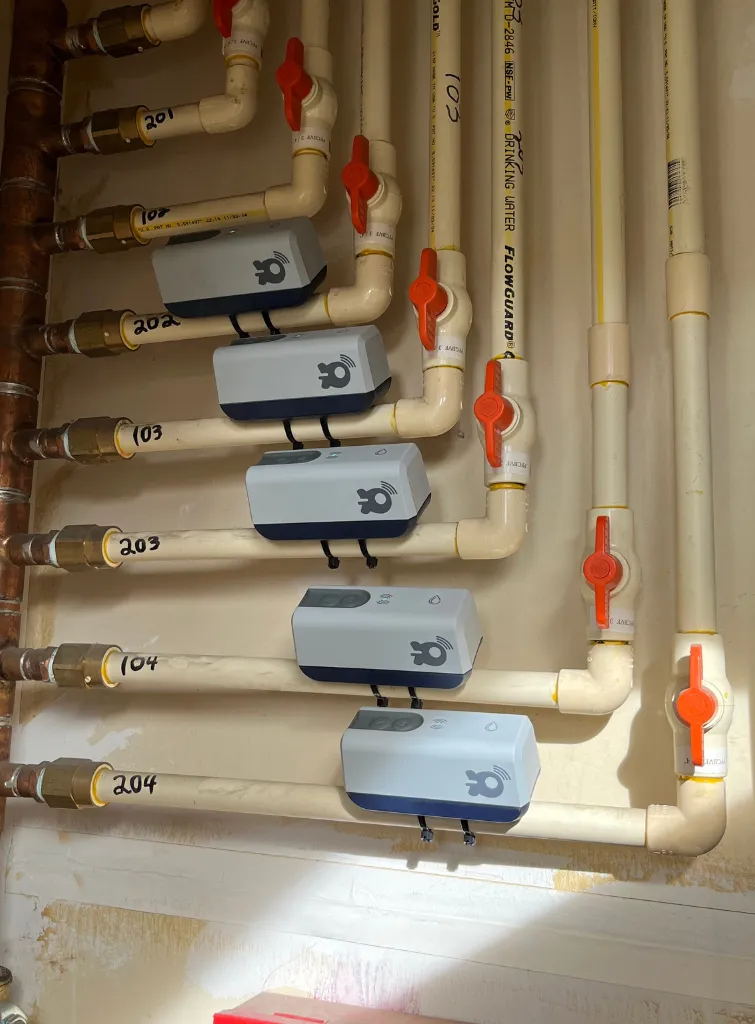
That's the gap water submetering closes. Submeters sit behind the utility's master meter and break the total down by who actually used it, unit by unit, in real time instead of monthly in arrears. The utility still reads one meter and sends one bill. You stop guessing about what's inside it.
For SimpleSUB customers, that usually means three things: usage-based billing that recovers 95%+ of water costs from the residents or tenants who actually used the water, 24/7 leak alerts that catch the running toilet in week one instead of on next month's bill, and unit-level data that ends the allocation arguments because there's nothing left to argue about. Residents on submeters typically use 15 to 40% less water once they can see what they're using.
The submeters are ±5% accurate, clamp onto the outside of the existing pipe with two zip-ties, and install in about five minutes per unit. No plumber, no pipe cutting, no water shutoff, no Wi-Fi.
If you're on an HOA board and the bill turned up something you now need to explain to the rest of the board, How to Build a Business Case for Water Submetering in Your HOA covers how to frame it. If the numbers pointed at a leak rather than irrigation, Why Your Water Bill Is Rising (Without Visible Leaks) is the better next read.
And the payoff worth naming: every gallon you stop wasting is a gallon that stays in your community's supply. SimpleSUB properties save over 9 million gallons a year between them. The financial case comes first because that's what gets a board to yes. Conservation is what you actually get.
Pull last month's bill and the same month from last year. Give it five minutes. The bill has been trying to tell you something.
FAQs
What does Ccf mean on a water bill?
Ccf means one hundred cubic feet, about 748 gallons. HCF means the same thing. It's the most common billing unit for US water utilities. Some utilities bill in kgal instead, meaning one thousand gallons.
Why is my sewer charge higher than my water charge?
Because treating wastewater generally costs more than delivering clean water. Sewer is calculated from your water usage rather than measured directly, since there's no meter on the drain, so it scales with everything you use including, on many commercial accounts, your irrigation.
Am I paying sewer charges on my irrigation water?
If your property is on a master meter, quite possibly. Winter averaging, which calculates sewer from cold-month usage when nobody's irrigating, is largely offered to residential accounts. Commercial and multifamily accounts are frequently billed on actual usage year-round with no such protection, which means the landscape shows up on the sewer line. Ask your utility which method applies to your account class, and whether an irrigation deduct meter is available.
Why did my bill go up when my usage stayed flat?
Rate increases, fee changes, or a longer billing period. Water rates have risen roughly 5% a year over the past decade. Check gallons per day across both periods before assuming anything changed at the property.
How can I tell if a spike is a leak or irrigation?
Timing and persistence. Irrigation tracks the season and drops when you shut the system down. A leak doesn't care what month it is and won't return to baseline on its own. If usage never comes back down to your winter floor, look for a leak. A master meter can't distinguish the two for you, which is the core limitation of reading a bill instead of measuring units.
My property has one master meter. Can I see usage by unit?
Not from the utility bill. The utility reads one meter and bills one total. Unit-level visibility requires submeters behind that master meter.
Request a Demo
We'll design an affordable, easy-to-install solution for your submetering project, large or small.