
How Tiered Water Rates and Drought Pricing Work (and Why Master-Metered Properties Pay the Most)
Articles
.svg)


Most U.S. water utilities price water in tiers: the more that flows through a meter in a month, the more each additional gallon costs. Drought pricing stacks temporary surcharges on top of those tiers when supplies run low. And master-metered properties pay the most because a single meter adds every unit, irrigation zone, and common area together, so the utility sees one enormous customer whose combined volume lands in the most expensive blocks on the rate schedule.
The numbers behind that structure are not small. A household might use 5,000 gallons a month and never leave the cheapest tier. A 60-unit community using the same amount per unit pushes 300,000 gallons through one meter, and a meaningful share of it can be billed at double the Tier 1 price or more. Add a drought surcharge, like the $1.10 to $2.20 per 1,000 gallons Denver Water began charging in 2026, or Austin's Stage 4 rate of $4.25 per 1,000 gallons, and the property is paying premium prices at scale for water nobody behind the meter ever saw a bill for.
This matters more right now than it has in years. Water and sewer bills are rising at their fastest pace in five years, more than half the lower 48 states are in drought as summer 2026 opens, and utilities from Colorado to Texas are activating drought rate stages. This guide explains exactly how tiered rates and drought pricing work, why master-metered properties absorb the worst of both, and what owners and boards can do about it. For broader context on unit-level metering, see The Ultimate Guide to Water Submetering.
Table of Contents
What Are Tiered Water Rates?
Tiered water rates, also called inclining block rates or increasing block rates, are a pricing structure where the per-gallon price of water rises as total usage rises within a billing period. The first block of water (often sized to cover essential indoor use like drinking, cooking, and bathing) is priced lowest. Each block after that costs more per unit, and the highest tier carries the highest price on the rate schedule.
How the Blocks Work
A simplified residential example looks like this:
- Tier 1: first 5,000 gallons at $4.00 per 1,000 gallons
- Tier 2: next 10,000 gallons at $6.50 per 1,000 gallons
- Tier 3: everything above 15,000 gallons at $9.00 per 1,000 gallons
A customer who stays in Tier 1 pays the lowest unit price for every gallon. A customer who reaches Tier 3 pays more than double for the gallons in that top block. The exact tier sizes and prices vary widely by utility, but the principle is the same everywhere: heavy usage is intentionally expensive.
Why Utilities Use Tiers
Tiered pricing exists for two main reasons. First, it encourages conservation by making waste cost more, which matters most in water-stressed regions. Second, it helps utilities recover the rising cost of treating and delivering water. Those costs have been climbing steeply: according to Bluefield Research's analysis of 50 major U.S. cities, combined household water and sewer bills rose 5.1% from 2024 to 2025, a five-year high, and the cost of water, sewer, and trash services has risen 207% since 2000, compared with 93% for overall inflation over the same period.
In other words, water rates have outpaced inflation for a quarter century, and the tier structure determines who absorbs the steepest part of those increases: the customers whose usage lands in the top blocks.
How Common Are Tiered Rates in the U.S.?
Very common, and most common where water is scarce. According to the AWWA and Raftelis Water and Wastewater Rate Survey, which collects rate data from hundreds of utilities across all 50 states, the increasing block structure is the most widely used residential rate structure in the country, with the heaviest adoption in the South and West, where conservation pressure is greatest. Utilities in the Northeast and Midwest use a more varied mix, with uniform (flat per-gallon) rates more common where water supplies are ample.
The practical takeaway for property owners: if your property is in the South, West, or any drought-prone market, your utility almost certainly prices water in tiers. And even in flat-rate markets, seasonal pricing and drought provisions are increasingly written into rate schedules.
What Is Drought Pricing?
Drought pricing is a temporary charge or rate adjustment a utility activates when water supplies fall below defined thresholds. Most utilities formalize this in a drought response plan with escalating stages (commonly Stage 1 through Stage 4), where each stage triggers tighter watering restrictions and, in many plans, additional charges layered on top of normal rates.
Drought surcharges serve two purposes at once. They push customers to cut discretionary use, especially outdoor watering, and they protect the utility's revenue while total consumption falls. Both purposes translate to the same thing on a customer's bill: the most expensive water of the year arrives during the driest months.
How Drought Stages Typically Work
While every utility writes its own plan, a typical structure looks like:
- Stage 1: Voluntary or limited mandatory restrictions, sometimes with modest surcharges on upper tiers
- Stage 2: Mandatory watering schedules and surcharges on usage above a baseline
- Stage 3: Steeper surcharges or percentage rate increases on high-volume use
- Stage 4: Significant flat surcharges on all usage above essential levels, with strict enforcement
Real Examples of Drought Surcharges Across the Country
Drought pricing is not theoretical, and this year it is not regional either. As summer 2026 opens, the U.S. Drought Monitor shows more than half of the lower 48 states in drought, with extreme to exceptional conditions entrenched in the West and Plains and dry conditions expanding across the Upper Midwest and Great Lakes.
Denver, Colorado. Following a winter of historically low snowpack, the Denver Board of Water Commissioners declared a Stage 1 drought in March 2026 and approved temporary drought pricing in April 2026, the utility's first drought pricing in more than 20 years. Residential customers pay a drought charge of $1.10 per 1,000 gallons on Tier 2 use and $2.20 per 1,000 gallons on Tier 3 use, layered on top of normal rates, in effect through April 2027 unless conditions improve. Notably for property owners, Denver Water's accompanying restrictions explicitly cover multifamily properties, commercial properties, and homeowners associations, which may water only two days per week.
Austin, Texas. Austin Water's drought rate provisions include a Stage 4 surcharge assessed as a flat $4.25 per 1,000 gallons on residential use above roughly 12,700 gallons per month, and on commercial irrigation accounts above roughly 5,200 gallons, in addition to standard rates.
Dallas, Texas. Dallas's drought plan has included a Stage 3 rate increase of 10% on usage above 10,000 gallons per month for high-demand users.
Southern California. Amid a decades-long megadrought that has drawn down aquifers and river flows, Southern California residents have seen water rate increases of up to 17% over the past two years, and utilities across the region maintain standing drought rate structures tied to state and local supply conditions.
Corpus Christi, Texas. After its reservoirs dropped to roughly a tenth of capacity, city officials projected that water rates would need to roughly double over the next few years to fund emergency supply projects, a reminder that drought costs persist in base rates long after the drought stage is lifted.
The pattern across all of these markets is consistent: drought charges target high-volume usage, they arrive in summer, and they are layered on top of tier structures that already price heavy use at a premium.
Why Master-Metered Properties Pay the Most
Here is the part of the rate schedule that rarely gets explained to property owners.
A master-metered property receives one bill for the combined usage of every unit, every irrigation zone, and every common area behind a single meter. To the utility's billing system, the property is one enormous customer.
Combined Usage Climbs the Tiers Fast
Tier thresholds are crossed by total metered volume. A single household might use 4,000 to 8,000 gallons per month. A 60-unit master-metered community using the same per-unit volume registers 240,000 to 480,000 gallons on one meter. Depending on how the utility classifies and tiers the account, a substantial share of that water can be billed at upper-tier prices that an individual household would rarely reach. The property pays a premium not because any one resident is wasteful, but because the meter adds everyone together.
Drought Surcharges Compound the Effect
Drought charges typically target usage above a baseline or in upper tiers, which is exactly where a master-metered property's combined volume sits. When a surcharge of $1.10 to $4.25 per 1,000 gallons lands on top of tiered rates, a property pushing hundreds of thousands of gallons through one meter absorbs it at scale.
Nobody Behind the Meter Sees a Price Signal
The deeper structural problem is informational. Tiered rates and drought surcharges are designed to change behavior through price. But on a master-metered property, residents never see the price of their own usage. The household running irrigation daily and the household away for three weeks pay the same share through rent, dues, or lot fees. The conservation signal the rate structure is built to send stops at the master meter, while the owner or association absorbs the full cost of it failing to arrive. For more on how this dynamic erodes operating budgets, see Why Your Water Bill Is Rising (Without Visible Leaks) and How to Stop It.
Why Summer Makes It Worse
Summer concentrates all of these costs into a single season. According to the U.S. EPA's WaterSense program, outdoor water use accounts for about 30% of total household use nationally, and as much as 60% or more in arid regions. EPA also estimates that as much as 50% of the water used outdoors is wasted through evaporation, wind, and runoff caused by inefficient irrigation.
For a master-metered property, that means the months of June through September deliver three compounding hits at once:
- Total usage rises sharply, pushing more volume into upper tiers
- Drought stages and surcharges, where active, take effect during the same months
- Irrigation waste, the most controllable portion of usage, hides inside one undifferentiated bill
A property owner reviewing the August statement is looking at the most expensive water of the year, priced at the highest tiers, with the least visibility into where it went.
Not Sure How Your Property's Rate Structure Is Affecting Your Bill?
Get a customized assessment of your property's usage profile and what unit-level metering would change, no plumbing modifications required.Schedule a Demo
What Property Owners and HOA Boards Can Do
Read Your Rate Schedule, Not Just Your Bill
Every utility publishes its rate schedule and drought response plan. Find out how your account is classified, where the tier thresholds sit, and what drought stage (if any) is currently active in your market. Many owners discover that a meaningful share of their bill is upper-tier or surcharge pricing they did not know existed.
Compare Gallons Year Over Year
Dollar totals hide rate increases. Comparing gallons against the same month last year shows whether usage behavior is actually changing, or whether you are simply paying more for the same water.
Separate and Manage Irrigation
Where possible, putting irrigation on its own meter or monitoring it separately isolates the most controllable and most heavily surcharged category of use. Smart controllers and seasonal scheduling directly reduce top-tier volume.
Fix the Structural Problem: Measure at the Unit Level
The steps above trim the bill. Submetering changes the structure that inflates it.
How Water Submetering Reduces Tiered and Drought Pricing Costs
Water submetering installs a meter at each unit so usage can be measured, monitored, and billed individually. In the context of tiered rates and drought pricing, it does four specific things:
It restores the price signal the rate structure was built on. When residents pay for their own measured usage, the conservation incentive that tiered pricing is designed to create finally reaches the people using the water. The effect is well documented: a two-year, EPA-funded national study of multifamily billing practices (conducted by Aquacraft with the East Bay Municipal Utility District) found that submetered properties used 15.3% less water on average, about 21.8 gallons per day per unit, while allocation formulas like RUBS produced no statistically significant savings. Less total usage means less volume billed in the top tiers and less exposure to drought surcharges.
It transfers usage-based costs to the people who control the usage. Instead of the owner or association absorbing tier penalties and drought charges across one combined bill, each unit's measured usage carries its own share. This is the core cost-transfer benefit of usage-based water billing.
It exposes leaks that tiered pricing makes expensive. A single running toilet can waste roughly 200 gallons per day, and on a master meter that waste is billed at the property's highest marginal tier while remaining invisible. Unit-level monitoring with automated alerts identifies continuous flow at a specific unit within days instead of billing cycles.
It gives boards and owners defensible numbers. Budget planning, dues discussions, and drought response all improve when the property knows exactly how much water goes to units versus common areas and irrigation. For associations, this is the foundation of a stable water line item; see How HOA Water Submetering Stabilizes Budgets and Strengthens Reserves.
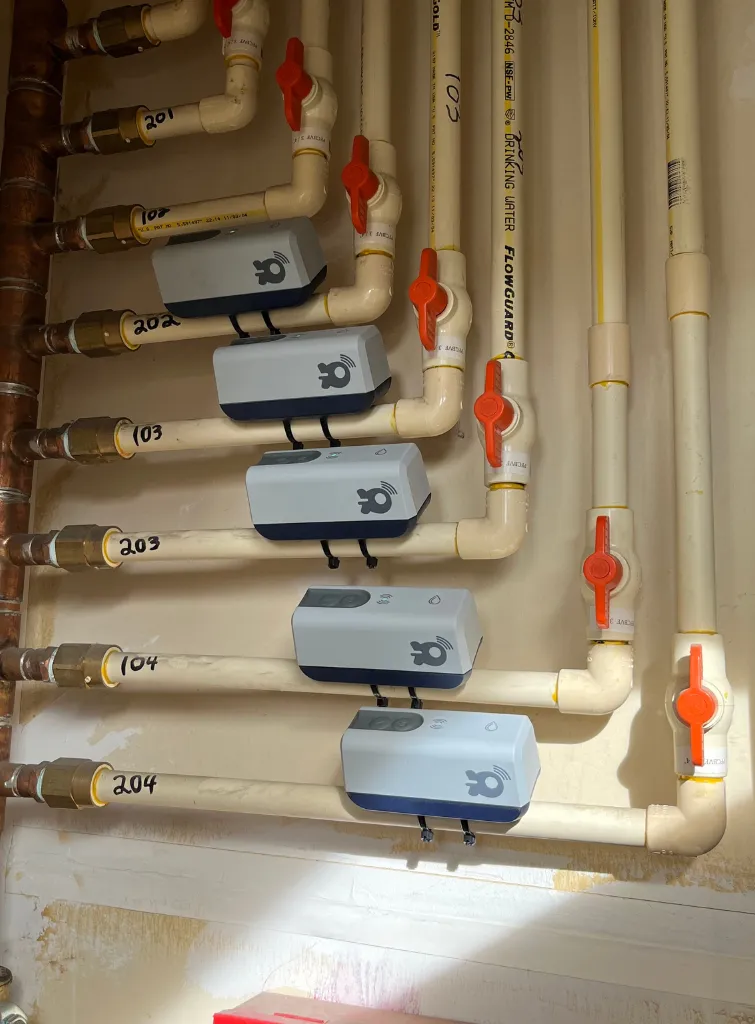
Modern clamp-on ultrasonic submeters, like SimpleSUB's, install on the outside of existing pipes without cutting plumbing or shutting off water, which makes retrofitting existing master-metered properties practical at any scale.
FAQs About Tiered Water Rates and Drought Pricing
1. What is a tiered water rate?
A tiered water rate (also called an inclining or increasing block rate) is a structure where the per-gallon price rises as total usage rises within a billing period. The first block of usage is cheapest and the highest block is most expensive.
2. What is a drought surcharge?
A drought surcharge is a temporary charge a utility adds on top of normal rates when a declared drought stage is in effect. Surcharges typically apply to usage above a baseline or in upper tiers and are designed to reduce discretionary use, especially outdoor watering.
3. Why do master-metered properties pay more under tiered rates?
Because one meter records the combined usage of every unit and common area, the property's total volume can land in the highest-priced tiers, even when no individual resident uses an unusual amount of water.
4. Are tiered water rates common in the United States?
Yes. Industry rate surveys from AWWA and Raftelis show increasing block rates are the most common residential rate structure nationally, with the heaviest use in the South and West.
5. Does water submetering reduce exposure to tiered and drought pricing?
Yes, in two ways. EPA-funded research found submetered multifamily properties use about 15.3% less water, which reduces volume billed in upper tiers, and usage-based billing transfers the remaining cost to the residents who control it.
6. Do drought charges apply to HOAs, apartments, and commercial properties?
In most plans, yes. For example, Denver Water's 2026 drought response explicitly applies watering restrictions to multifamily properties, HOAs, commercial properties, and government properties, and its drought pricing covers residential, irrigation, and wholesale customer classes.
What's Next?
If rising rates, tier penalties, or drought surcharges are showing up in your property's water costs, the structural fix is visibility. Contact SimpleSUB Water for a customized submetering assessment, or start with The Ultimate Guide to Water Submetering for a complete grounding in how unit-level metering works.
This blog post was written by water submetering specialists at SimpleSUB Water, a provider of unit-level water metering solutions for HOAs, apartments, mobile home parks, and commercial properties across the U.S.
Sources and Further Reading:
https://www.raftelis.com/insight/how-do-your-rates-rate/
https://www.awwa.org/data-products/rate-survey/
https://www.epa.gov/watersense/statistics-and-facts
https://www.drought.gov/national
https://www.simplesubwater.com/resources/ultimate-guide-to-water-submetering
Disclaimer: SimpleSUB’s water submetering and billing features may not be permitted in all states or local jurisdictions. You are solely responsible for ensuring that your use of any billing or cost-recovery tools complies with all applicable laws and regulations in your area. Nothing on this page (or elsewhere on our site) should be considered legal advice. You should consult your own legal counsel before implementing any billing practices.
Request a Demo
We’ll design an affordable, easy-to-install solution for your submetering project, large or small.
Read Related Articles

How Tos
Articles
Ultimate Guide

