
Why Water Matters So Much for HOAs
For many homeowners’ associations (HOAs), water is one of the fastest-growing and least predictable expenses in the budget. Across the U.S., water and sewer rates have surged in recent years, while aging infrastructure and higher insurance premiums keep pushing costs up.
In many HOAs, water is not metered individually. Instead, it is bundled into a general “utilities” category or hidden in monthly dues. Owners pay the same amount regardless of how much water they use, and no one can see whether a spike in the bill is caused by leaks, irrigation, or a handful of high-use units.
Submetering fixes that. By installing individual water meters for each home, submetering aligns payment with actual usage. Owners pay for what they consume, and the HOA can remove unit water usage from the operating budget. That shift restores fairness, accountability, and control at a time when water costs are rising faster than almost any other expense.
How the Traditional “Water Included” Model Hurts HOAs
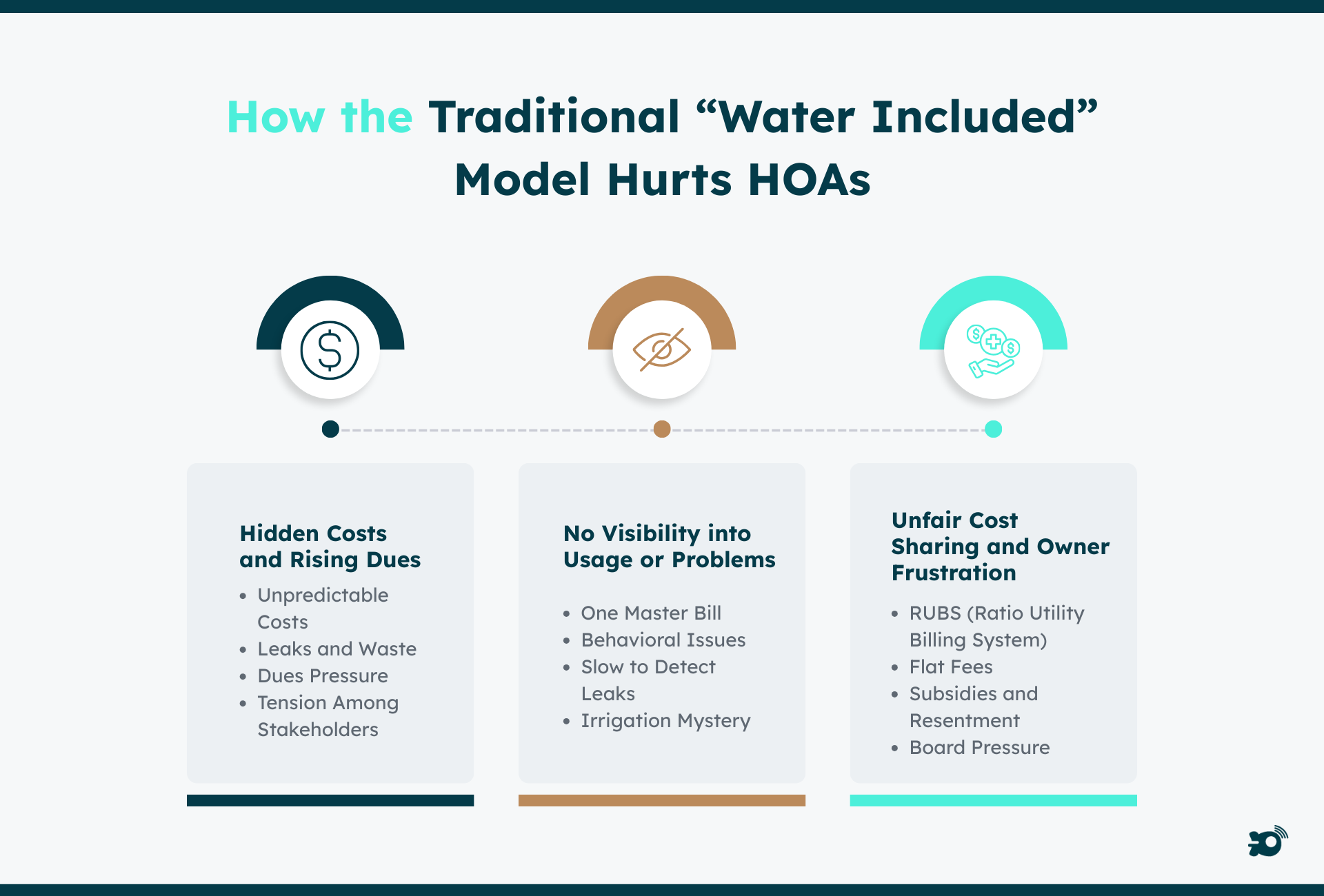
Here’s how the traditional method of billing for water usage hurts HOAs.
Hidden Costs and Rising Dues
As we mentioned above, in many associations, water costs are put into a broad “utilities” category or simply included in monthly dues. On paper, that might look simpler, but it obscures one of the most volatile parts of an HOA’s budget.
- Unpredictable Costs: Water is often one of the largest operating expenses for HOAs, and its cost isn’t fixed. Rate increases, infrastructure upgrades, or even regulatory changes can drive sudden spikes. For example, many U.S. cities are raising rates to cover deferred maintenance or regulatory compliance.
- Leaks and Waste: Without individual meters, leaks can go undetected for a long time. A single hidden leak can waste thousands of gallons of water a month, silently inflating the master meter bill.
- Dues Pressure: When water costs surge, the board faces a tough choice: raise dues, tap reserves, or cut services. Frequent surprises can erode financial stability and strain reserve funds.
- Tension Among Stakeholders: Boards, management companies, and residents all bear different burdens. But under a “water included” model, there’s no clear way to see who is driving cost overruns or efficiency. Low-use residents might feel they’re subsidizing heavier users. And they are!
The bottom line here is that hiding water costs in the budget might seem simpler in theory, but in practice, it erodes transparency, strains finances, and frustrates stakeholders.
No Visibility into Usage or Problems
When water is paid from a master meter without submetering, the HOA lacks unit-level data. That leaves significant blind spots.
- One Master Bill: The entire building or community is billed together, and costs are pooled. It’s difficult, if not impossible, to tell how much comes from leaks vs. high-consumption units vs. irrigation.
- Behavioral Issues: Without visibility, residents have little incentive to conserve. If you don’t see your daily or monthly usage, you’re less likely to change your habits.
- Slow to Detect Leaks: Leaks in residents’ units or common lines might go unnoticed until the next billing cycle (if not longer). By then, the damage might be done, the costs are already ballooning and everyone pays more.
- Irrigation Mystery: Outdoor water use (landscaping, common areas) can distort total usage, but without submeters, the HOA has no granular way to allocate that cost fairly.
This lack of insight makes it difficult for a board to make informed decisions, prioritize repairs, or promote conservation. And that can leave owners feeling disconnected and powerless.
Unfair Cost Sharing and Owner Frustration
Even when HOAs try to allocate water costs fairly, the usual methods fall short.
- RUBS (Ratio Utility Billing System): Many associations use RUBS to prorate the water bill across units based on factors like square footage or number of occupants. But RUBS is inherently imperfect. It assumes equal behavior rather than actual usage.
- Flat Fees: Some HOAs simplify administration with flat water fees for everyone, but that punishes low users and rewards waste.
- Subsidies and Resentment: Under these shared systems, responsible residents (those who conserve or repair leaks quickly) are effectively subsidizing heavier users or those with plumbing issues. That can lead to resentment, disputes, and even heated board meetings.
- Board Pressure: Without real-time usage data, boards struggle to communicate the rationale behind dues or utility assessments, and owners feel in the dark or distrust how costs are allocated.
In short, traditional “water included” models undermine fairness, inflame tension, and disempower both the board and individual owners.
What Water Submetering Is and How It Works in an HOA
So, exactly how does water submetering work in an HOA? Let’s take a look.
Simple Definition
Water submetering is a straightforward concept with powerful results. Instead of one master meter measuring usage for the whole community, each home receives its own dedicated water meter. This allows usage to be tracked and billed individually, just like electricity or gas.
Here’s what that means in practice:
- Each home gets its own meter that records actual consumption.
- Usage data is captured automatically, usually every hour or day.
- Each owner receives an individual bill based on the water they personally use.
- The HOA pays only for common-area water, not every unit’s total consumption.
With a submetering provider like SimpleSUB, the entire process is automated. Meters send usage through LTE (cellular), bills are generated monthly, and both owners and boards gain clear visibility and control.
How It Changes the Dynamic
Submetering transforms water from a shared mystery expense into a normal, individually managed utility. For the first time, both the HOA and owners can see what’s actually happening behind the master meter.
This shift creates several important changes:
- Fairness becomes the default. Owners pay for their own use.
- High-use residents can no longer drive up costs for everyone else.
- Boards get unit-level data to diagnose problems before they escalate.
- Usage transparency naturally reduces waste, because people change their behavior when they see their consumption.
- Owners feel in control, which increases satisfaction and reduces disputes.
Simply enabling residents to see their water usage can reduce consumption dramatically. When HOAs pair submetering with transparent billing, savings often follow within the first billing cycle.
Modern Technology for Existing Buildings
Older HOAs often assume submetering requires major construction, and it used to. But modern technology makes installation fast, affordable, and non-invasive.
Today’s systems, such as those used by SimpleSUB Water, rely on:
- Ultrasonic, Over-the-Pipe Submeters. These meters clamp onto existing pipes, so there’s no need to cut plumbing or open walls.
- LTE-Connected Devices. Each meter transmits readings using cellular networks instead of WiFI. This ensures accuracy and avoids connection issues in dense buildings or older structures.
- High Accuracy and Long Lifespan. Ultrasonic meters have no moving parts, meaning excellent durability and consistent performance over time.
- Minimal Disruption During Installation. Most units take less than an hour to install. Water shutoff windows are short, and work is usually done during standard business hours.
Modern submetering technology removes the installation barriers that once discouraged HOAs. Submetering is now practical for nearly any building type, mid-rises, garden-style condos, townhome communities, and even older infrastructure.
The HOA-Level Benefits:
Budget, Risk, and Governance
Now, we’ll look at the HOA-level benefits.
Pulling Water Out of the Operating Budget
When HOAs pay for all unit water through the operating budget, every rate increase, leak, or irrigation issue hits the bottom line. Submetering changes all that.
Once each owner pays individually, here is what you can expect:
- Unit water usage is removed from the HOA budget.
- Dues can be stabilized or strategically reduced.
- Large swings in water costs stop impacting reserves.
- Future budgeting becomes more predictable and less stressful.
Water is often one of the largest line items in an HOA’s operating budget. It’s commonly 30–40% in communities where unit water is included. Pulling that cost out fundamentally changes the financial stability of the association.
It also reinforces strong fiduciary management, which owners and prospective buyers increasingly expect.
More Predictable Financial Planning
One of the biggest challenges HOAs face is volatility. Water bills are never fixed. A single leak can distort an entire quarter’s financials. Submetering provides the data and structure needed to take back control.
The benefits include:
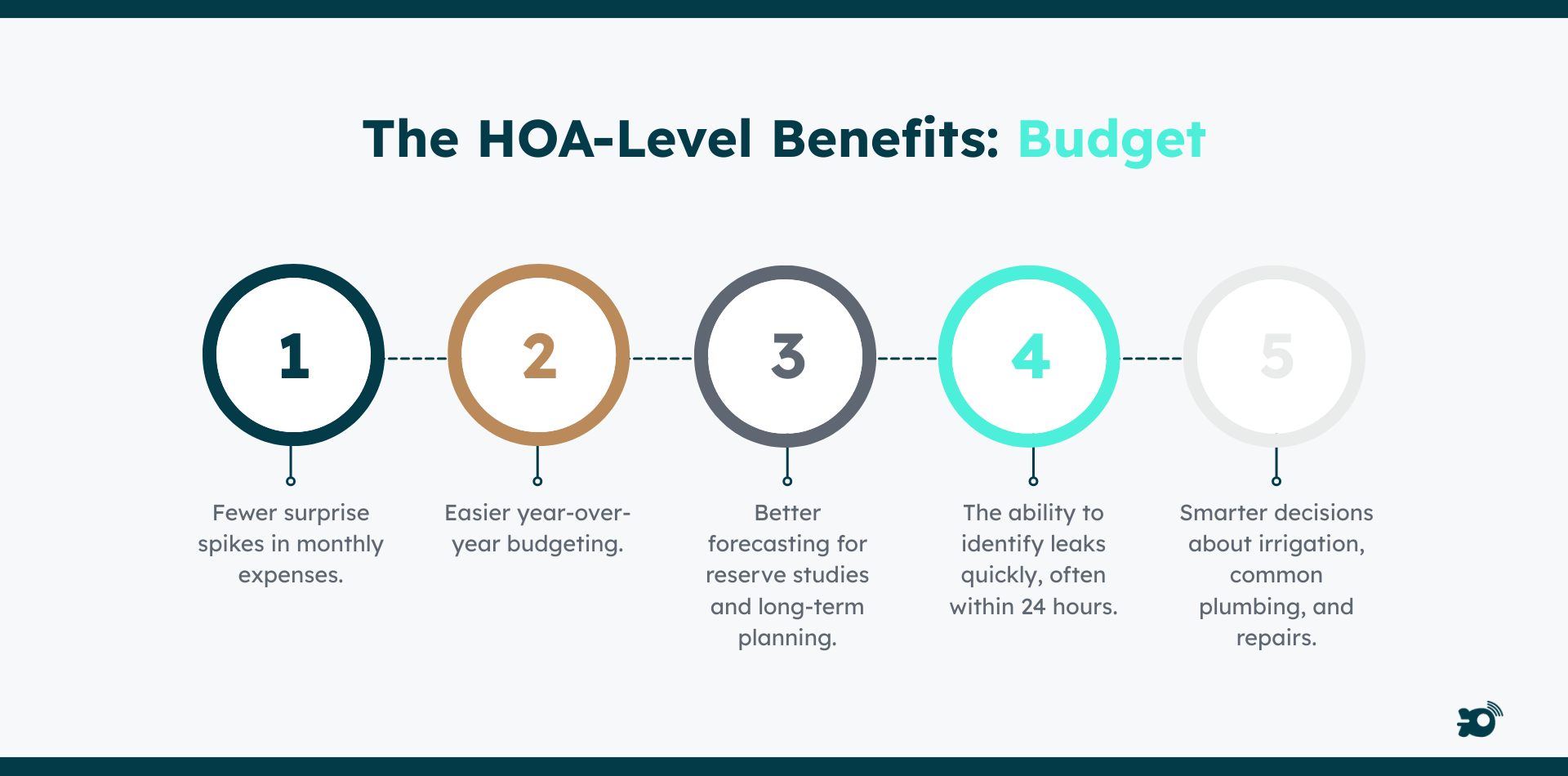
- Fewer surprise spikes in monthly expenses.
- Easier year-over-year budgeting.
- Better forecasting for reserve studies and long-term planning.
- The ability to identify leaks quickly, often within 24 hours.
- Smarter decisions about irrigation, common plumbing, and repairs.
Accurate metering gives the board a reliable baseline to build from, rather than fluctuating master meter bills that hide problems.
Better Governance and Transparency
Strong, clear governance is one of the biggest selling points of a well-run HOA. Submetering supports that in several ways.
- Transparent billing eliminates confusion and frustration among owners.
- Boards can clearly explain how water is billed and why.
- Residents see evidence of responsible financial management, improving trust.
- Future buyers and lenders appreciate the documented stability, supporting property values.
- Disputes decrease dramatically because bills are tied to individual usage, not shared assumptions.
In short, submetering removes the guesswork. It builds credibility and reduces friction. The two elements that significantly improve the experience of living in an HOA community.
The Owner-Level Benefits:
Control, Fairness, and Savings
Here is what HOA residents can expect.
Paying Only for What You Use
The most important benefit for owners is simple: fairness.
Under a master-meter model, everyone pays into a pool that includes leaks, waste, and high-use neighbors.
With submetering:
- Owners pay only for their actual water usage.
- Low-use owners stop subsidizing high-use units.
- Bills directly reflect personal habits and choices.
- Billing feels fairer and more transparent, reducing resentment.
All of these factors help gain support for the system. When residents see that they finally have control over their portion of the bill, most respond positively, even those who use more water.
Behavior Change and Waste Reduction
People change what they can see. Once owners receive monthly usage reports, even small insights lead to meaningful changes.
- Shorter showers.
- Fixing dripping faucets.
- Upgrading old toilets or appliances.
- Reporting leaks promptly.
- Reducing excessive irrigation.
Studies show individual metering reduces water consumption by 15–30% in multifamily settings. HOA communities frequently land in the upper range because the combination of fairness and visibility encourages accountability.
Personal ROI from Leak Detection and Habit Changes
.png)
One overlooked benefit of submetering is how quickly owners identify and fix costly leaks. A toilet leak alone can waste up to 200 gallons of water per day. Under a shared-bill model, an owner may never know it’s happening. Under submetering, abnormal usage is clear in the billing data because automated alerts from systems like SimpleSUB notify owners within hours rather than months.
Even small behavioral changes can create measurable savings.
- Replacing an old showerhead can save 500 gallons per year.
- Fixing a dripping faucet saves up to 3,000 gallons per year.
- Modern toilets use 60% less water than older models.
These things add up quickly. For many owners, savings from leaks alone can offset their share of the submetering investment within the first year.
Making It Affordable:
Shared Cost, Shared Upgrade
Here’s why upgrading to a water submetering system is a win-win for everyone.
Why Submetering Is Especially Feasible for HOAs
Submetering is often more cost-effective in HOAs than in apartments for one key reason: the cost is shared across many owners who all directly benefit.
In an apartment building with a single owner, the landlord carries the entire financial burden of installing submeters across all units, even though tenants receive most of the behavioral and usage benefits. That dynamic makes adoption less appealing.
But in an HOA:
- Every owner is already paying for water, whether they realize it or not.
- Any increase in the master meter bill directly impacts everyone through higher HOA fees.
- When submeters are installed, each owner gains full control over their usage, not a landlord.
- Lower HOA fees increase property values and improve affordability.
Because the upside flows back to the community, HOAs are uniquely positioned to benefit from submetering as a shared investment.
Structuring the Cost
The most common and transparent way to fund a submetering project is through a one-time assessment spread evenly across all units. Boards typically frame this as a capital improvement, because it is.
- It modernizes the building.
- It eliminates a volatile operating expense.
- It provides individual billing transparency.
- It stabilizes the community’s long-term financial health.
HOAs can also structure payments over time. Here is how some communities do just that.
- Use reserve contributions if the study supports it.
- Offer installment plans for owners.
- Tie the investment to documented ROI projections.
- Present a side-by-side comparison showing dues with and without submetering.
When residents see that the assessment leads to lower dues and more control over their utility bills, support typically increases. Tools from providers like SimpleSUB make the financial modeling easy to present at membership meetings.
Case Study:
Property: Greentree Commons Condominiums Association
Type: HOA/Condo Association
Location: Chesapeake, VA
Meter Count: 83 units
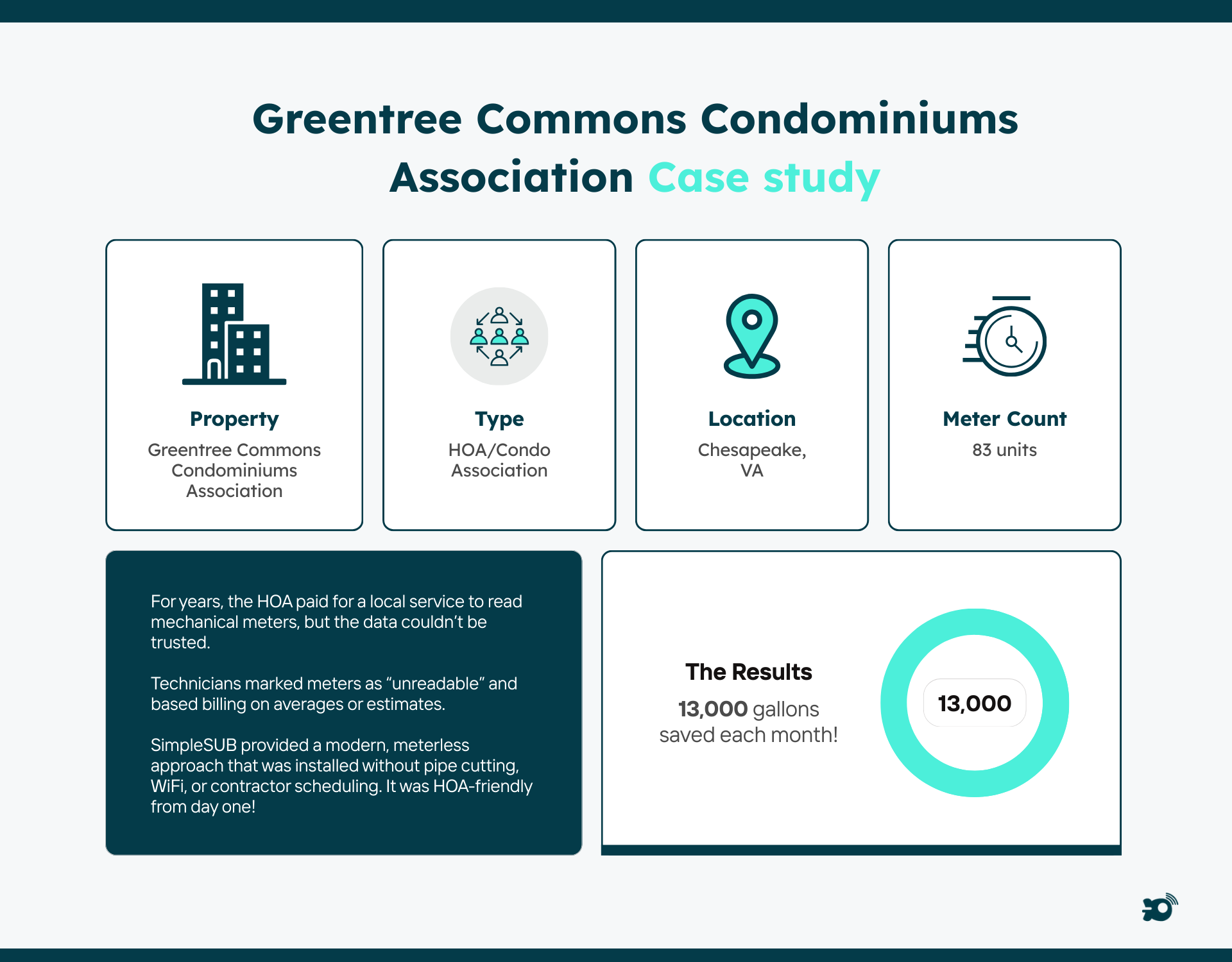
For years, the HOA paid for a local service to read mechanical meters, but the data couldn’t be trusted. Technicians marked meters as “unreadable” and based billing on averages or estimates. SimpleSUB provided a modern, meterless approach that was installed without pipe cutting, WiFi, or contractor scheduling. It was HOA-friendly from day one!
The Results: 13,000 gallons saved each month!
Positive ROI for Owners and the Association
Submetering is one of the rare HOA projects that produces a return rather than a recurring cost.
Here’s how ROI shows up for owners:
- Lower monthly HOA fees.
- Lower personal water bills through mindful usage.
- Leaks are identified and stopped quickly.
- Increased transparency and confidence in the community’s management.
- Higher property values because dues fall or stabilize.
Here’s how ROI shows up for the HOA:
- Water volatility was removed from the operating budget.
- Stronger reserves and cleaner financial statements.
- Fewer surprise expenses driven by leaks.
- Faster financial decision-making using accurate usage data.
- Increased attractiveness to buyers and lenders.
Many HOAs find that unit-level savings alone offset the cost of submetering within the first few years.
Property Values and Marketability
Here’s how submetering will affect your property value and how you market your property.
The Impact of Lower and More Stable Dues
Real estate agents, lenders, and buyers all look closely at HOA dues. High or unpredictable fees can turn buyers away, especially in competitive markets.
Submetering helps HOAs:
- Reduce or stabilize dues by removing unit water usage from the budget.
- Show clear financial stewardship.
- Demonstrate that leadership is proactively managing rising utility costs.
Buyers consider HOA fees a major factor when comparing properties. And, for 44% of homebuyers, being a member of an HOA is an important factor when it comes to buying their homes, and they are happy about their decision.
Lower dues make listings more competitive. More predictable dues make them more attractive. Submetering supports both.
Modern Utility Setup as a Selling Point
Buyers increasingly want communities that feel modern, fair, transparent, and sustainable. Submetering touches all these points.
.png)
Benefits that support the sales narrative include:
- Individually metered utilities. Just like a single-family home.
- Usage-based billing that rewards efficient owners.
- Modern ultrasonic technology that doesn’t require major plumbing work.
- Better control over monthly costs.
- Reduced HOA dues, often highlighted in listing descriptions.
HOAs frequently feature submetering in their marketing materials because it signals a well-run, responsive community.
Long-Term Value Creation
Submetering doesn’t just fix a budget problem. It creates lasting infrastructure that benefits the community for decades.
Long-term value includes:
- Permanent reduction in financial risk.
- Long-lasting meters that require minimal maintenance.
- Ongoing usage visibility for future boards and owners.
- More sustainable water behavior across the community.
- Stronger reserve health through predictable budgeting.
- Higher resale values thanks to transparent and equitable utility management.
Communities that adopt submetering frequently see measurable improvements in both buyer interest and owner satisfaction.
Stonegate HOA Case Study
Property: Highlands at Stonegate North HOA
Type: Multi-building HOA community
Location: Parker, Colorado
Meter Count: 446+ submeters
The Problem
The Highlands at Stonegate community HOA included water in its dues. As water and sewer rates climbed over the past decade, the master meter bill became unpredictable.
They struggled with:
- Rising utility bills impacting dues.
- Owner frustration over lack of transparency.
- An inability to locate leaks without costly plumbing inspections.
- Confusion during annual meetings about why fees kept increasing.
Water had become the HOA’s most volatile expense and major source of tension.
What They Did
After reviewing proposals, Stonegate partnered with SimpleSUB to install ultrasonic, over-the-pipe submeters on every unit.
The community:
- Installed new submeters across all buildings.
- Transitioned from “water included” dues to usage-based billing.
- Added leak detection alerts for each unit.
- Adjusted HOA dues to remove individual water consumption from the operating budget.
The process took less than two weeks with minimal interruption.
The Outcomes
Within the first billing cycle, Stonegate saw immediate improvements:
- Transparent billing. Every owner received a breakdown of their actual usage.
- Lower pressure on the HOA budget, since unit usage was removed.
- Behavior changes. Owners began fixing leaks and adjusting their habits.
- Improved community relations by replacing confusion and resentment with fairness and transparency.
- Increased marketability. Realtors emphasized lower dues and modern infrastructure.
Their board now uses submetering data to track trends, detect leaks early, and project future budgets with confidence.
Result Numbers and Valuable Wins
With more than 446 meters installed in just a few weeks, the HOA saw results almost immediately.
- 38% drop in water usage in two months (Jan: 1.872M gallons to March: 1.12M gallons).
- $20,000–$30,000 refund recovered from correcting a misread city meter.
- Multiple hidden leaks were detected and repaired right away.
- Residents saved $50–$70 per month on average.
- Major installation savings versus a traditional system.
The submetering system gave homeowners visibility, control, and incentives to conserve, while enabling the HOA to reclaim control over water expenses.
Quotes from Sherri, HOA Board President
“Until people start getting their own bill, they won’t care. When water is hidden in assessments, people waste it, and the community as a whole pays.”
“SimpleSUB made the extra effort. The ROI is absolutely there. It’s better than continuing to throw money at rising utility bills.”
“For any HOA struggling with water accountability, non-intrusive submeters with real-time monitoring are the only practical path forward. SimpleSUB delivers powerful results without the risks and costs of traditional systems.”
How Installation and Billing Work (High Level)
Here’s a look behind the scenes to see how submetering installation and billing work.
Assessment and Design
Every successful submetering project starts with a detailed review of the following.
- Current master meter bills.
- Plumbing layout and unit access locations.
- Irrigation lines and common-area fixtures.
- Building age, materials, and shutoff valves.
- Any past history of leaks or pressure issues.
Providers like SimpleSUB use this information to design a tailored solution for the community, identify installation points, and determine the most cost-effective path forward.
Installation Process
Modern submetering is far simpler than most HOAs expect.
Typical installation steps include:
- Meters are installed “over the pipe” in stacks, closets, or mechanical areas.
- Installers schedule short water shutoff windows so multiple units can be completed at once.
- No walls need to be opened, and no piping needs to be cut.
- LTE-connected devices transmit usage data automatically.
- Residents experience minimal disruption (usually less than one hour per unit).
The speed and simplicity make it suitable even for older communities or buildings with limited access space.
Billing and Ongoing Operations
Once meters are installed, the ongoing process is highly automated.
- Usage is read automatically through LTE.
- Individual bills are generated monthly for each owner.
- Boards and managers receive dashboards to monitor trends.
- Automated alerts flag leaks or abnormal consumption.
This makes submetering a true set-it-and-forget-it solution for the HOA. Boards get clearer oversight. Owners get control. The community gains long-term stability.
Implementation Roadmap for HOAs
Implementing a submetering system in an HOA requires careful planning, clear communication, and phased execution. By approaching the project methodically, boards can ensure a smooth transition that maximizes benefits for both the community and individual owners.
Gather Data and Define the Problem
The first step is to gather comprehensive data about the community’s water usage.
Boards should collect:
- At least twelve months of water bills.
- Current budget allocations for utilities.
- Leak history or plumbing issue reports.
This data helps quantify how much water is costing the HOA and highlights areas where waste might exist. Understanding the scope of the problem allows the board to clearly demonstrate the financial impact of water expenses on dues and reserves.
Get Proposals and ROI Estimates
Once the problem is defined, solicit proposals from submetering providers, including options like a SimpleSUB quote. Providers typically offer tailored plans detailing equipment, installation, billing, and ongoing support. When reviewing proposals, boards should compare the following.
- Type of meter (over-the-pipe, inline, etc.)
- Installation timeline and disruption estimates.
- Type of connectivity (cellular, WiFi, etc.).
- The battery life.
- Does it have 24/7 leak alerts and tamper detection?
- Does it offer automatic meter reads?
- Total project cost and per-unit share for homeowners.
- Expected savings and ROI over time.
A thorough evaluation ensures the HOA makes a financially informed decision and builds a strong case for owner approval.
Communicate with Owners and Secure Approval
Clear, transparent communication is essential for a successful rollout.
Boards should explain:
- Why water is a challenge today.
- How submetering resolves fairness and transparency issues.
- How it promotes sustainability.
- Any expected changes to individual bills and HOA dues.
Providing visual examples, projected savings, and an estimated payback period helps homeowners understand the benefits. Hosting meetings (virtual or in-person) encourages questions and engagement, increasing the likelihood of approval.
Install, Test, and Transition
Installation is typically phased to minimize disruption. Modern over-the-pipe ultrasonic meters can be installed quickly, often without major plumbing modifications. After installation, a test period ensures accuracy by comparing submeter readings to the master meter. Once verified, the HOA can do the following.
- Remove unit water costs from the budget.
- Begin individual billing for each homeowner.
- Monitor usage and detect leaks in real time.
This careful transition ensures both accuracy and homeowner confidence.
Monitor Results and Share Wins
Ongoing monitoring is crucial to realizing the full benefits of submetering.
Boards should:
- Track total usage and costs.
- Respond promptly to leak alerts.
- Review financial outcomes against projected savings.
Sharing quarterly or annual results with homeowners highlights tangible benefits, promotes conservation, and reinforces trust between the board and residents.
A Quick Review
Submetering transforms water from a hidden, unpredictable expense into a fair, transparent utility that homeowners can manage themselves. It allows boards to stabilize or reduce dues while protecting reserves and gives owners control over their personal water usage.
Key benefits include:
- Fair billing for each homeowner.
- Early detection of leaks and water waste.
- Improved budgeting and financial predictability.
- Enhanced property values through modern infrastructure.
Even a modest one-time assessment can yield a positive ROI for both the community and individual owners. The long-term benefits extend beyond your finances, creating a more accountable, sustainable, and attractive community.
What’s Next?
HOAs ready to explore submetering can take the following next steps:
- Request an HOA-specific submetering proposal from SimpleSUB.
- Obtain a ROI analysis to estimate community-wide savings.
- Consult with a submetering specialist to discuss installation, billing, and ongoing support.
By following these steps, boards can turn water management from a recurring challenge into a strategic opportunity, delivering measurable value for both the HOA and its residents!
The sooner you install your submeters, the sooner you’ll see the savings!
Disclaimer: The information provided in this guide is for general educational and informational purposes only. It is not intended as legal, financial, or engineering advice, nor should it be relied upon as a substitute for professional consultation. Property owners and managers should consult with qualified experts, local authorities, and licensed contractors before making decisions regarding water submetering, resident billing, or related utility management practices. SimpleSUB Water makes no representations or warranties, expressed or implied, about the accuracy, completeness, or applicability of the content in specific situations. All utility regulations, building codes, and compliance requirements vary by jurisdiction and are subject to change.
Request a Demo
We'll design an affordable, easy-to-install solution for your submetering project, large or small.